Jacksonville, FL
Water Heater Repair & Installation in Jacksonville, FL
We repair and replace tank and tankless water heaters, gas and electric, across Jacksonville — and we will tell you honestly which one your unit needs. A heater under about eight years old with a failed part is usually worth repairing; one past twelve years leaking from the tank itself is not.
Open 24 hours · FL License CFC1430743 · Free estimates
Last updated:
What the symptom usually means
No hot water, water that runs hot then goes cold in five minutes, rusty water, popping or rumbling from the tank, or a puddle underneath — each of those points at a different failure, and they do not all mean you need a new heater.
- No hot water at all — failed element, thermostat, pilot or breaker
- Hot water runs out fast — sediment buildup or a broken dip tube
- Rusty or metallic-smelling hot water — a spent anode rod, or a tank starting to corrode
- Popping, rumbling or knocking — sediment scaling on the tank bottom
- Water pooling under the tank — could be a fitting, could be the tank; the difference decides repair versus replace
- Relief valve dripping — pressure or temperature is too high and needs looking at, not capping
What's included
- Tank water heater repair and full replacement
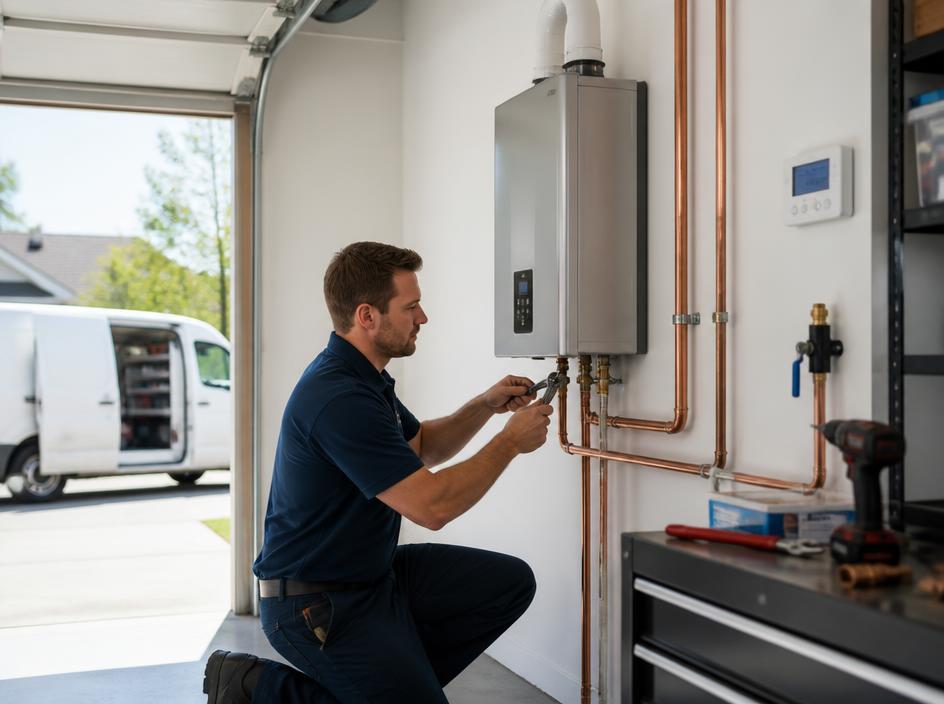
- Tankless repair, descaling and installation
- Thermostat, heating element, thermocouple and gas valve service
- Anode rod replacement and sediment flushing
- Expansion tank, pan, drain line and code-compliant venting
- Haul-away and disposal of the old unit
How we handle it
Diagnose the real fault
We test the unit rather than guessing from its age. Elements, thermostats, gas valves and dip tubes all fail in ways that look identical from the shower.
Repair or replace — with the reasoning
You get both numbers where both are viable, plus how much life a repair realistically buys. We do not push a replacement on a heater that has years left.
Install to code
Correct venting, a drain pan piped to a safe discharge point, an expansion tank where the pressure calls for one, and new flex connectors and shutoff — not the twenty-year-old ones.
Test and hand over
We bring the unit up to temperature, check for leaks at every joint, set a safe thermostat point, and show you the shutoff and the drain valve before we leave.
Tank vs tankless in a Jacksonville home
Both work well here. Which one fits depends on how much hot water you use at once, where the unit lives, and how long you plan to stay in the house.
| Factor | Tank | Tankless |
|---|---|---|
| Hot water supply | Limited to the tank size — run it out and you wait for it to recover. | Continuous, but limited by flow rate: two showers plus a dishwasher can outrun a small unit. |
| Typical service life here | About eight to twelve years with our mineral-heavy water. | Longer, often fifteen years or more, provided it is descaled yearly. |
| Space | Takes a garage corner or a dedicated closet. | Wall-mounted, frees the floor space back up. |
| Install work | Usually a straight swap when sizes match. | May need a larger gas line, new venting or a dedicated circuit. |
| Upkeep | Annual flush, anode rod checked every few years. | Annual descaling, inlet filter cleaned. |
| Failure mode | Tank eventually leaks — water on the floor, which is why the pan matters. | Components fail rather than the tank; no stored water to spill. |
What moves the price on a water heater job
We do not publish dollar figures, because the same symptom can be a small part or a full replacement. These are the things that actually change the number, so you know what we are looking at during the diagnosis.
Repair or replacement
A thermostat, element, thermocouple or anode rod is a parts-and-labor repair. A corroded tank is a new unit plus disposal of the old one.
Fuel type and capacity
Gas, electric and tankless units differ in equipment cost and in the work needed to feed them safely.
Where the unit sits
A garage swap is straightforward. An interior closet, an attic or a tight crawlspace adds access time and often a new pan and drain line.
Bringing the install up to code
Venting, an expansion tank where pressure calls for one, a pan piped to a safe discharge point, and new shutoff and flex connectors instead of the old ones.
Timing
A scheduled daytime visit is priced differently from a 2 a.m. emergency, and we say which one you are getting on the phone.
What it costs
Every plumbing price depends on the problem — what's actually failing, where it sits in the house, and how much has to be opened up to reach it. We diagnose first, explain what we found, and give you a firm price before any work starts. You approve the number before we pick up a tool, and there is no charge for changing your mind.
Why it happens here
North Florida's hard, mineral-heavy water is rough on water heaters — sediment scales the tank bottom and shortens tankless service intervals, so Jacksonville heaters often need flushing more often than the manual suggests. Most homes here also put the heater in the garage or an interior closet, which makes the pan and drain line the difference between a wet floor and a ruined ceiling.
Common questions
Other plumbing services
24/7 Emergency Plumbing
We answer the phone 24 hours a day, every day of the year, at (904) 862-6927 — including nights, weekends and …
Drain Cleaning & Clog Removal
We clear kitchen, bathroom, laundry and main sewer lines with drain machines and hydro jetting, then camera-in…
Leak Detection & Repair
We locate leaks under slabs, behind walls and in supply and irrigation lines using acoustic listening and pres…
Fixture Installation
We install faucets, toilets, sinks, showers, tub valves and garbage disposals to code, replace the worn shutof…
Commercial Plumbing
We service restaurants, offices, retail spaces and multi-unit properties across Jacksonville, scheduling aroun…
Whole-Home Repiping
We assess aging or repeatedly leaking supply pipes and explain whether a targeted repair or whole-home repipe …
Well Pump Repair
We diagnose private-well water supply problems, including pumps, pressure tanks and switches, for North Florid…
New Construction Plumbing
We provide new construction plumbing for residential and commercial projects, with scope and scheduling agreed…
Areas we serve
Need Water Heater Repair & Installation today?
Call (904) 862-6927 — we answer 24 hours a day — or request a free estimate online.